

Mixing is an important step in many manufacturing processes. Raw materials must be blended evenly before they move to the next production stage. Poor mixing can cause changes in colour, taste, texture, strength, or product performance.
A Ribbon Blender Machine offers a fast and effective way to mix dry powders, granules, and some semi-wet materials. It is widely used in food, pharmaceutical, chemical, agricultural, plastic, and construction industries.
The machine is known for its simple design and uniform mixing ability. It can process both small and large batches. This article explains how a Ribbon Blender Machine works and explores its top industrial applications.
What Is a Ribbon Blender Machine?
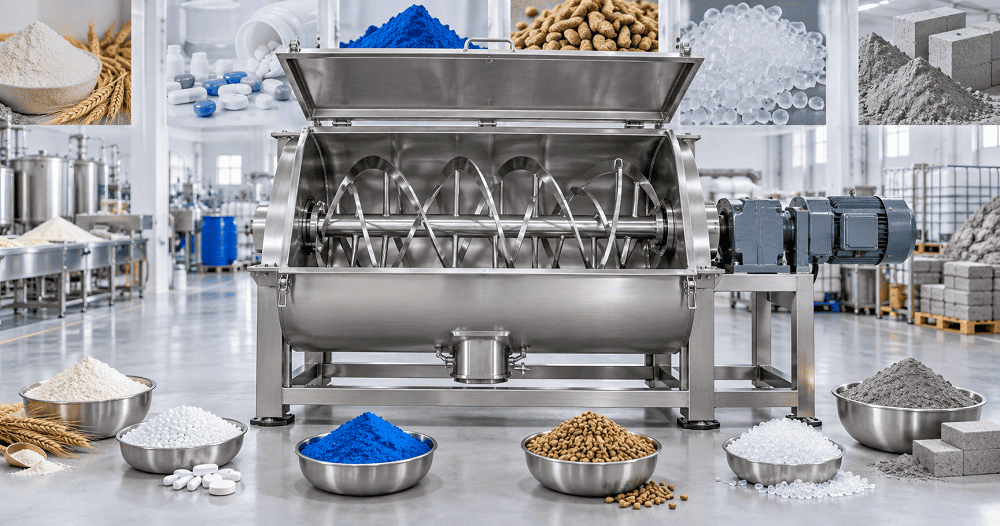
A Ribbon Blender Machine is an industrial mixing machine. It usually has a horizontal U-shaped container and a central rotating shaft. Inner and outer ribbon-shaped blades are fitted to the shaft.
These ribbons move the material in opposite directions. The outer ribbon pushes material towards one end of the container. The inner ribbon moves it in the opposite direction. This movement creates a continuous mixing pattern.
The material moves from side to side and from the centre towards the outer area. This action helps distribute every ingredient throughout the mixture.
After mixing is complete, the finished material leaves through a discharge outlet at the bottom.
Main Benefits of a Ribbon Blender Machine
A Ribbon Blender Machine is popular because it offers several useful benefits:
- Fast and uniform mixing
- Simple operating process
- Low energy use
- Large batch capacity
- Gentle handling of materials
- Easy loading and unloading
- Low maintenance requirements
- Flexible machine design
- Suitable for different materials
- Easy integration with production lines
The machine can also be customised with different construction materials, motor sizes, blade designs, and discharge systems.
1. Food Processing Industry
The food industry is one of the largest users of ribbon blenders. Food products often contain several dry ingredients that must be mixed evenly.
A Ribbon Blender Machine can be used for:
- Flour blends
- Spice mixtures
- Bakery premixes
- Soup powders
- Drink powders
- Seasoning blends
- Milk powder mixtures
- Protein powders
- Tea blends
- Coffee mixtures
- Sugar-based products
- Cereal mixes
Uniform mixing is important in food production. Each package should contain the correct amount of every ingredient. Uneven blending may affect flavour, colour, texture, and nutritional value.
Food-grade ribbon blenders are normally made from stainless steel. They have smooth contact surfaces and easy-to-clean parts. This helps manufacturers maintain hygiene and reduce contamination risks.
2. Pharmaceutical Industry
Pharmaceutical products require accurate and consistent mixing. Each batch must contain the correct amount of active and supporting ingredients.
A Ribbon Blender Machine can mix:
- Pharmaceutical powders
- Vitamin blends
- Mineral supplements
- Herbal powders
- Dry syrup ingredients
- Nutritional supplements
- Excipients
- Tablet production materials
The machine gently moves the ingredients without creating excessive heat. This can protect materials that are sensitive to temperature.
Pharmaceutical ribbon blenders usually require hygienic construction. Product-contact parts may be made from high-grade stainless steel. The machine should also be easy to clean between batches.
The selected blender must follow the required production and quality standards. Proper testing is important before using it for a pharmaceutical product.
3. Chemical Manufacturing
Chemical manufacturers handle powders and granules with different densities and flow properties. These materials must often be mixed before packing or further processing.
A Ribbon Blender Machine is used for:
- Detergent powders
- Cleaning chemicals
- Fertiliser mixtures
- Pigments
- Dyes
- Industrial salts
- Water-treatment chemicals
- Adhesive powders
- Resin compounds
- Laboratory chemical blends
The machine can provide even distribution of small ingredients throughout a larger batch. This is important when additives form only a small part of the final mixture.
Some chemicals may be corrosive or hazardous. In such cases, the blender needs suitable construction materials, seals, covers, and electrical protection.
A closed blender can also help control dust and reduce product loss.
4. Animal Feed Production
Animal feed contains grains, minerals, vitamins, and other nutrients. These ingredients must be blended evenly to provide consistent nutrition.
Ribbon blenders are used to produce:
- Cattle feed
- Poultry feed
- Fish feed
- Pet food premixes
- Mineral mixtures
- Vitamin supplements
- Protein-based feed
- Feed additives
Uniform mixing helps ensure that each portion of feed has a balanced composition. It also reduces the chance of some animals receiving too much or too little of a certain ingredient.
A Ribbon Blender Machine can process large batches in a short time. This makes it useful for commercial feed plants and agricultural production units.
5. Agricultural Products
Agricultural manufacturers use ribbon blenders to mix powders, granules, and additives. The machine is suitable for products that need even distribution before packing or field application.
Common applications include:
- Fertiliser mixtures
- Soil conditioners
- Micronutrient blends
- Seed-treatment powders
- Pesticide powders
- Organic manure mixtures
- Bio-fertiliser products
An even mixture helps the final product perform more consistently. For example, a fertiliser blend should deliver similar nutrient levels in every portion.
The machine must be selected based on the material’s density, moisture, and abrasive nature. Stronger ribbons may be required for heavy agricultural products.
6. Cosmetics and Personal Care Products
Cosmetic products need a smooth and uniform texture. Any uneven colour or ingredient distribution can affect the product’s appearance and performance.
A Ribbon Blender Machine may be used for:
- Face powders
- Talcum powders
- Herbal cosmetic powders
- Bath salts
- Dry shampoo powders
- Cosmetic pigments
- Clay masks
- Personal care premixes
Stainless steel construction is commonly preferred for these applications. Smooth internal surfaces make the blender easier to clean.
Some cosmetic powders are very fine and may create dust. A covered blender with suitable seals can help keep the material contained.
Careful speed control may also be required to protect delicate ingredients.
7. Plastic and Polymer Industry
Plastic manufacturers use ribbon blenders to combine raw materials before extrusion, moulding, or another production process.
Common applications include:
- Plastic granules
- Polymer powders
- Colour masterbatch
- Plastic additives
- Resin mixtures
- Recycled plastic flakes
- Filler compounds
- PVC dry blends
Uniform mixing helps distribute colours, stabilisers, fillers, and other additives throughout the base material.
Consistent material can improve the colour, strength, finish, and performance of the final plastic product.
Plastic compounds may produce static electricity or dust. The machine should include proper grounding and safety features when required.
8. Construction Material Industry
Construction materials often contain powders with different weights and particle sizes. These ingredients need proper mixing to deliver consistent performance.
A Ribbon Blender Machine can be used for:
- Dry mortar
- Wall putty
- Tile adhesive
- Cement-based products
- Gypsum mixtures
- Grout
- Plaster products
- Repair compounds
- Waterproofing powders
These materials can be heavy and abrasive. The machine needs a strong shaft, durable ribbons, and a powerful drive system.
Wear-resistant contact parts may also be required. A properly selected blender can produce uniform mixtures while handling demanding working conditions.
9. Paint, Pigment and Coating Industry
Paint and coating manufacturers use ribbon blenders for dry ingredients and powder-based products.
Applications include:
- Powder coatings
- Colour pigments
- Dry paint mixtures
- Ceramic colours
- Masterbatch pigments
- Mineral fillers
- Coating additives
Even pigment distribution is essential for a consistent colour. Poor mixing can create shade differences between batches.
The machine should prevent material build-up in corners and around the shaft. Smooth surfaces and a well-designed discharge valve make cleaning easier during colour changes.
A dust-control system may be required when handling very fine pigments.
10. Nutraceutical Industry
Nutraceutical manufacturers produce health supplements and nutrition products. These products often contain vitamins, minerals, proteins, herbs, and other dry ingredients.
A Ribbon Blender Machine can mix:
- Protein powders
- Meal replacement powders
- Herbal supplements
- Vitamin premixes
- Mineral blends
- Sports nutrition products
- Health drink powders
- Dietary supplement ingredients
Ingredient distribution is very important in these products. Each serving should contain a consistent blend.
Hygienic design and easy cleaning are also necessary. Manufacturers should select food-grade contact parts and suitable seals.
11. Ceramic and Mineral Industry
Ceramic and mineral materials can be dense, abrasive, and difficult to mix. Ribbon blenders are used when these powders need to be combined evenly.
Applications include:
- Ceramic powders
- Clay mixtures
- Mineral blends
- Refractory materials
- Silica-based products
- Foundry compounds
- Glass raw materials
Heavy materials place more pressure on the motor, gearbox, shaft, and blades. The blender should be designed for the actual bulk density of the product.
A standard machine made for light powder may not be suitable for heavy minerals. A material trial can help determine the correct motor power and blade design.
12. Spice and Seasoning Production
Spice and seasoning blends require careful mixing. A small amount of one ingredient can strongly affect the taste and colour of the full batch.
Ribbon blenders can mix salt, herbs, spices, flavours, starch, and other dry ingredients. The machine helps distribute them across the entire mixture.
Gentle blending helps protect delicate herbs and flakes. The correct speed should be used to avoid breaking the product too much.
Easy cleaning is important when changing from one flavour to another. Any material left in the machine can affect the next batch.
Factors to Consider When Selecting a Ribbon Blender
A suitable Ribbon Blender Machine should be selected according to the product and production process.
Important factors include:
- Type of material
- Bulk density
- Particle size
- Required batch capacity
- Mixing time
- Moisture level
- Material flow
- Construction material
- Motor and gearbox size
- Discharge design
- Cleaning requirements
- Dust-control needs
- Available installation space
The blender should not be filled completely. Enough free space is needed for material movement. The manufacturer can recommend the correct working volume.
How to Improve Ribbon Blender Performance
Good operating practices can improve mixing quality and machine life:
- Follow the recommended loading order.
- Do not overload the mixing chamber.
- Use the correct mixing time.
- Inspect ribbons and weld joints.
- Check the shaft and bearings.
- Clean the blender after every batch.
- Monitor unusual noise or vibration.
- Check the discharge valve for leakage.
- Replace worn seals and parts.
- Follow a regular maintenance schedule.
Operators should also record batch size, mixing time, and product results. These details help maintain consistency.
Conclusion
A Ribbon Blender Machine is a practical solution for mixing powders, granules, and selected semi-wet materials. Its inner and outer ribbons create a continuous mixing action. This helps distribute ingredients throughout the batch.
The machine is widely used in food, pharmaceutical, chemical, animal feed, agriculture, cosmetics, plastics, construction materials, coatings, and nutraceutical production. It offers fast mixing, flexible capacity, simple operation, and low maintenance.
The correct model should be selected according to material type, density, batch size, and hygiene needs. Motor power, ribbon design, machine material, and discharge style are also important.
A well-designed Ribbon Blender Machine can improve product consistency and production efficiency. It can also reduce mixing time, material waste, and manual labour. Regular cleaning and maintenance will support safe operation and long-term performance.