

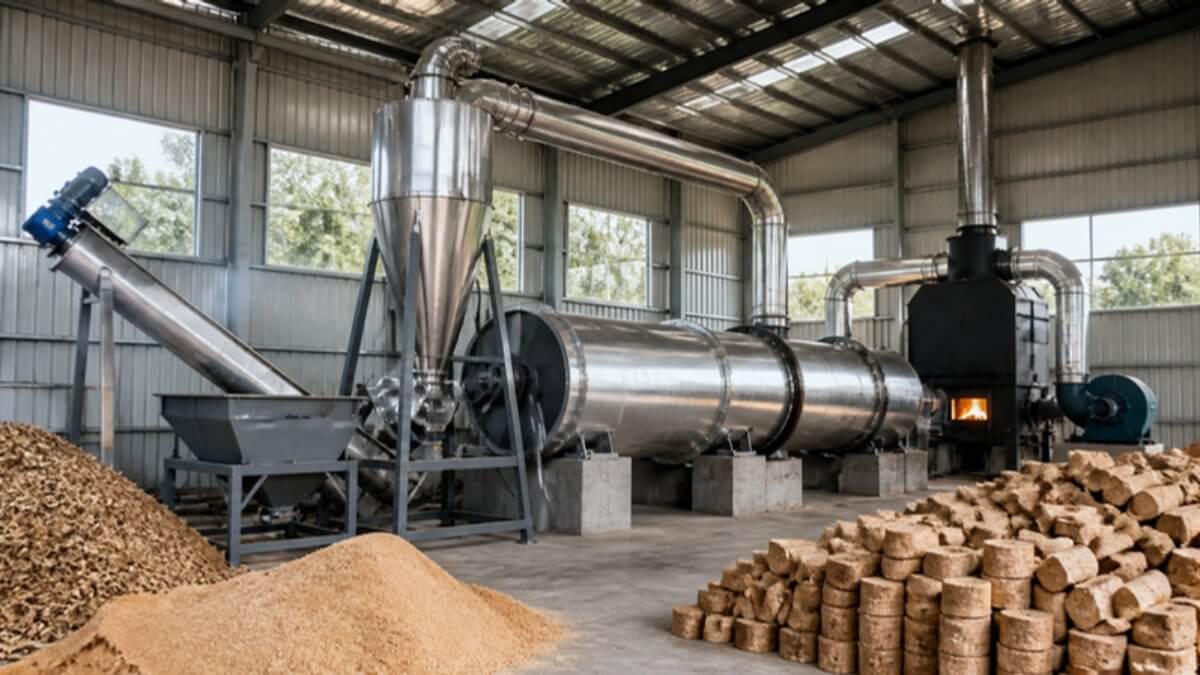
Every harvest season leaves behind mountains of rice husk, cotton stalks, groundnut shells and corn cobs. Sawmills and furniture workshops produce sawdust and wood shavings every single day. For years, much of this was burned in the open or left to rot. Today, more businesses are turning these leftovers into clean, solid fuel, and the step that makes it possible is drying. A dependable Biomass Dryer System is what turns wet, bulky waste into feedstock that can be pressed into briquettes and pellets.
The Problem With Wet Biomass
Fresh agricultural and wood residue can hold 30 to 40 percent water. That water adds weight, lowers heat value and makes the material difficult to compress. Briquette presses and pellet mills need feedstock at roughly 8 to 15 percent moisture to produce dense, smooth and long-lasting fuel. Sun drying works on a small scale, but it is slow, depends on the weather and simply cannot keep a commercial plant running all year.
Wet feedstock also creates practical headaches on the shop floor. Steam builds up inside the press, briquettes swell or crack after leaving the die, and screws and rams wear out faster. The result is lower output, more rejected product and higher maintenance bills.
What Is a Biomass Dryer System?
A biomass dryer system is a set of connected machines that removes excess moisture from loose biomass in a controlled, continuous way. Unlike open-air drying, it delivers material at a consistent moisture level regardless of season, rainfall or humidity. Most systems used in briquetting and pellet plants are flash or turbo-type dryers, where fine material is carried by a stream of hot air and dried within seconds.
What Happens Inside a Biomass Dryer
Most industrial biomass dryers follow a straightforward flow:
- Feeding: Milled wet biomass is fed into the system through a hopper and screw or belt conveyor.
- Heating: A hot air furnace, usually fired with biomass waste or briquettes, produces high-temperature air.
- Drying: An ID fan pulls the material and hot air through a drying pipeline, removing moisture within seconds.
- Separation: A cyclone separator collects the dried material and releases the moist air.
- Dust control: Fine particles are captured before air leaves the system.
The result is a continuous stream of dry, uniform material ready for the briquette press, pellet mill or biomass boiler.
Raw Materials That Can Be Dried
One of the biggest strengths of a well-designed dryer is flexibility. The same system can usually handle a wide range of residues, including sawdust, wood chips, wood powder, rice husk, bagasse, bamboo dust, cotton stalks, groundnut shells, corn cobs, mustard husk, forestry waste and pre-processed municipal solid waste. For the best results, material should first be reduced in a hammer mill to a small and even particle size so that it dries uniformly.
Why It Matters for Sustainability
Dried biomass fuel replaces coal, firewood and furnace oil in boilers, kilns and industrial heaters. Using farm and wood waste this way reduces open burning, cuts landfill load and gives farmers and sawmills an additional income stream. Because the dryer’s own furnace can run on biomass, the process stays low-cost and largely self-sustaining. For factories trying to reduce their carbon footprint, switching to briquettes made from properly dried biomass is one of the most affordable steps available.
Who Uses Biomass Dryers?
- Biomass briquette and pellet manufacturers
- Sawmills and wood processing units
- Sugar mills handling bagasse
- Rice mills with large volumes of husk
- Biomass power plants and industrial boiler operators
- Municipal solid waste processing facilities
How to Choose the Right Biomass Dryer System
Before buying, it helps to think beyond the price tag. Start with the raw material you will process and its moisture level in different seasons. Then decide the target output moisture your press or pellet mill needs. Capacity is usually quoted in tonnes per hour, but the real figure depends on input moisture, particle size, climate and material type, so ask the manufacturer for a rating based on your own feedstock.
Also look closely at the furnace design and insulation, the efficiency of the fan, the cyclone and dust collection arrangement, and whether a PLC control panel is available for stable temperature control. Finally, check the supplier’s experience, installation support and spare-parts availability, especially if your plant is in a remote location.
Tips for Getting the Best Results
- Grind material to a small, even size in a hammer mill before drying.
- Keep the feeding rate steady to avoid over-drying or under-drying.
- Monitor furnace temperature and output moisture regularly.
- Clean the cyclone and ducting on a set schedule to maintain airflow.
- Store dried material under cover so it does not reabsorb moisture.
- Train operators to spot early signs of blockages or uneven drying.
Conclusion
Turning waste into fuel is one of the most practical ways to support renewable energy and the circular economy. Drying is the step that makes the whole process work, improving fuel quality, protecting downstream machinery and keeping production steady regardless of the season. With the right biomass dryer system in place, agricultural and wood residues stop being a disposal problem and become a reliable, profitable source of clean energy.