

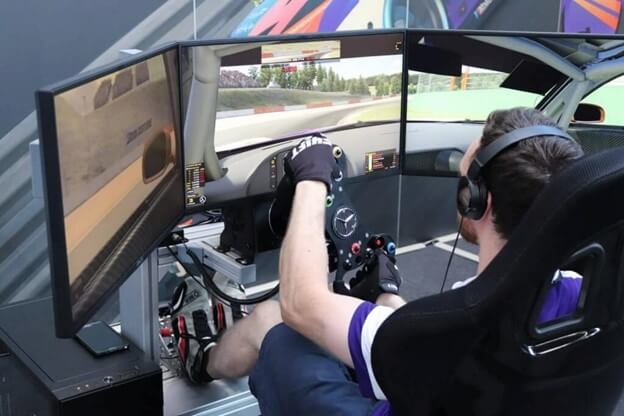
Arcade racers throw you into instant chaos and cinematic speed, while sim racing demands precision, patience, and respect for real-world physics. From the accessible thrills of Need for Speed to the unforgiving realism of iRacing, the difference isn’t just how fast you go—it’s how you drive. Let’s break down handling models, driver skill demands, hardware differences, and what truly separates a game from a simulator.
Introduction
Racing games do not belong to a single, uniform category. They sit across a broad spectrum shaped by contrasting design priorities. At one end is sim racing, developed to replicate real-world motorsport with high levels of accuracy and discipline, often supported by specialised hardware such as the Simagic GT NEO, which reinforces precise control and realistic feedback. At the other is arcade racing, built around immediacy, accessibility, and fast-paced enjoyment.
While both formats place players behind the wheel of virtual cars, the experience quickly diverges. Vehicle behaviour, tolerance for mistakes, and the path to improvement vary significantly between the two. These differences influence how players approach each game, how skills are developed, and what kind of engagement the experience ultimately delivers.
The Real Difference Between Sim Racing and Arcade Racing
The key difference lies in intent. Sim racing aims to replicate reality. Developers study real cars, real tracks, and real data. The objective is accuracy. If a car behaves unpredictably in real life, it behaves the same way in the simulation.
Arcade racing games prioritise entertainment. Realism is adjusted or removed if it slows the experience. Cars accelerate faster, corner harder, and recover quickly from mistakes. The aim is to keep players moving and engaged at all times.
This split influences every design choice. Sim racing rewards understanding and consistency. Arcade racing rewards speed and confidence. One reflects how motorsport actually works. The other creates an idealised version that anyone can enjoy without preparation.
Realism Is the Goal in Sim Racing, Not Just Entertainment
Realism in sim racing extends beyond visuals. Tyre grip changes with temperature and wear. Fuel load affects balance. Weather alters braking distances. Tracks evolve as rubber builds up on the racing line. These details demand constant attention from the driver.
Arcade racers simplify these systems. Grip remains stable. Weather effects are often cosmetic. Cars perform consistently regardless of conditions. This predictability keeps gameplay smooth but removes strategic depth.
Because of this, sim racing often encourages specialised equipment. Steering feedback, pedal resistance, and seating position all matter. Hardware such as the Simagic GT NEO reflects how sim racing values accurate input and tactile response, even though success still depends on driver skill rather than equipment alone.
Driving Physics That Reward Precision
In sim racing, physics punishes errors. Brake too late and the car will not stop. Apply throttle too early and the rear will step out. Overcorrect the steering and control is lost. Every action has consequences.
Arcade racing games soften these effects. Cars slide predictably. Recovery systems keep the vehicle pointed forward. Crashes rarely end a race. Players are encouraged to push limits without fear.
This difference changes how players approach driving. Sim racers focus on smooth inputs and repeatable lap times. Arcade players focus on overtaking and spectacle. One is methodical. The other is expressive. Both are intentional, but they deliver very different forms of satisfaction.
Control Systems Designed for Skill, Not Assistance
Sim racing controls are direct. The game does not hide poor technique. Steering input is translated precisely. Braking requires modulation. Traction control, if present, mirrors real systems rather than masking mistakes.
Arcade games rely heavily on assistance. Steering correction, stability aids, and simplified braking help players stay competitive. These systems are invisible by design. They ensure players feel fast, even without technical knowledge.
As a result, sim racing has a steep learning curve. Early laps can feel difficult and unforgiving. Arcade racing feels welcoming from the first session. This contrast explains why sim racing attracts long-term commitment, while arcade racing excels at short play sessions.
Progression Built on Practice Instead of Power-Ups
Progression in sim racing is measured by improvement. Faster lap times. Better racecraft. Cleaner driving. There are no shortcuts. Advancement comes from learning tracks, understanding car behaviour, and refining technique.
Arcade racing progression is often external. New cars unlock. Boosts increase speed. Visual rewards mark advancement. Skill still matters, but it is supported by game mechanics rather than being the sole driver of success.
This shapes motivation. Sim racers chase mastery. Arcade players chase momentum and rewards. Neither approach is inferior. They simply reflect different expectations of what a racing game should provide.
Competitive Culture Shapes How Each Genre Is Played
Sim racing competition mirrors real motorsport. Races follow structured formats. Clean driving is enforced. Penalties matter. Reputation within the community carries weight. Arcade racing competition is looser. Matches are shorter. Contact is expected. Rules are flexible. The focus is on participation rather than discipline.
These cultures reinforce the core differences between the genres. Sim racing treats racing as a skill to be developed. Arcade racing treats racing as a shared experience to be enjoyed.
Simulation or Arcade: Choosing the Experience That Fits Your Intent
Sim racing and arcade racing games serve different purposes. One offers depth, realism, and long-term progression. The other offers speed, accessibility, and immediate enjoyment. Understanding how they differ makes it easier to choose the experience that matches personal goals.
Whether a player seeks authentic motorsport or fast-paced entertainment, both genres continue to thrive by delivering exactly what their audiences expect.
Frequently Asked Questions
Q1. Is sim racing harder to learn than arcade racing games?
Yes. Sim racing has a steeper learning curve because it relies on realistic physics and precise control. Players must learn braking points, racing lines, and car balance. Arcade racing games are designed to be easier to pick up, using assisted handling and simplified mechanics to deliver immediate enjoyment.
Q2. Do arcade racing games require real driving skills?
Arcade racing games use basic driving ideas, but they do not demand true driving technique. Systems are built to reduce the impact of mistakes. While speed and reactions matter, players are not expected to manage grip, braking precision, or weight transfer in the same way as sim racing.
Q3. Why do sim racing cars feel more difficult to control?
Sim racing cars feel harder to control because they respond like real vehicles. Grip levels change, errors have consequences, and assists are limited. Poor inputs are exposed rather than corrected automatically. Arcade racing games soften these behaviours to keep the experience smooth and forgiving.
Q4. Can arcade racing games still be competitive?
Yes. Arcade racing can be competitive, but the structure is different. Races are shorter, contact is often expected, and rules are relaxed. Sim racing competition follows stricter formats, with penalties and clean driving standards similar to real motorsport.
Q5. Is sim racing only for serious or professional players?
No. Sim racing attracts enthusiasts at all levels. While it demands patience and learning, many players enjoy the process of gradual improvement. It is suited to those who value realism and long-term skill development rather than quick results.
Q6. Which offers better long-term engagement: sim racing or arcade racing?
Sim racing usually offers deeper long-term engagement because improvement depends on personal skill growth. Arcade racing focuses on fast fun and variety. The better option depends on whether a player prefers mastery and realism or quick, casual entertainment.
Conclusion
Sim racing and arcade racing games are shaped by fundamentally different priorities. Sim racing is built around realism, precision, and technical understanding. It asks players to learn, adapt, and improve through practice, mirroring the demands of real-world motorsport. Every input matters, and progress is earned through consistency rather than shortcuts.
Arcade racing games, by contrast, are designed for accessibility and immediate enjoyment. They remove complexity to keep the experience fast and engaging. Both approaches are valid and continue to coexist because they serve different player intentions. Choosing between them depends on whether the goal is authentic driving discipline or uncomplicated digital entertainment.