
Have you ever wondered what separates a good engine build from a truly bulletproof one? What’s the secret sauce that allows some Barra engines to smash through the 1,000-horsepower barrier while others struggle to stay together? And why are so many Australian performance enthusiasts specifically hunting down billet crankshafts for their builds?
The Ford Barra engine has earned legendary status in the Australian performance scene. It’s become the go-to powerplant for drag racers, street machines, and serious enthusiasts chasing big numbers. But here’s the thing – when you start pushing serious power, your stock components become the weakest link in the chain. That’s where a billet crankshaft comes into play, transforming your Barra from a solid performer into an absolute weapon.
In this article, we’ll break down everything you need to know about billet crankshafts for your Barra build. You’ll discover what makes billet different from other crankshaft types, when it’s time to upgrade, what features matter most, and how to avoid costly mistakes. Whether you’re planning a mild street build or chasing four-digit horsepower figures, understanding your crankshaft options is absolutely key to building an engine that’ll handle whatever you throw at it.
Understanding the Ford Barra Engine
A Brief History of the Barra Engine
The Barra engine first appeared in 2002, powering the BA Falcon series. Ford Australia developed this inline-six as a modern replacement for the aging Intech engine. From the factory, it came in various configurations – naturally aspirated versions producing around 182kW, and the turbocharged variants that quickly caught the attention of performance enthusiasts.
What made the Barra special was its robust architecture. The cast-iron block, aluminium head, and strong bottom end gave tuners a solid foundation to work with. Over the years, the engine evolved through the BF, FG, and FG X Falcon models, with the turbocharged versions becoming increasingly potent from the factory.
Why the Barra Has Become a Favourite for Performance Builds
The Barra’s popularity in the performance world isn’t accidental. Its long-stroke design produces impressive torque, while the factory turbo variants respond brilliantly to modifications. Plus, the aftermarket support is enormous – you can source everything from bolt-on upgrades to complete race-spec components.
Another factor is the engine’s relatively affordable entry point. Compared to building a high-powered V8, a Barra build often delivers more bang for your buck. The smooth power delivery of an inline-six, combined with turbocharger boost, creates a combination that’s both driveable and devastatingly quick.
What Is a Billet Crankshaft?
Billet vs Cast vs Forged Crankshafts: What’s the Difference?
Understanding crankshaft manufacturing methods is vital when planning a serious build. Cast crankshafts are the most basic – molten metal poured into a mould. They’re cheap to produce but have inherent weaknesses due to porosity and inconsistent grain structure. Most stock engines use cast cranks because they’re cost-effective for factory power levels.
Forged crankshafts represent a step up. Here, heated steel gets hammered into shape under extreme pressure, aligning the metal’s grain structure for improved strength. Many performance engines come with forged cranks from the factory, and they handle significantly more stress than cast alternatives.
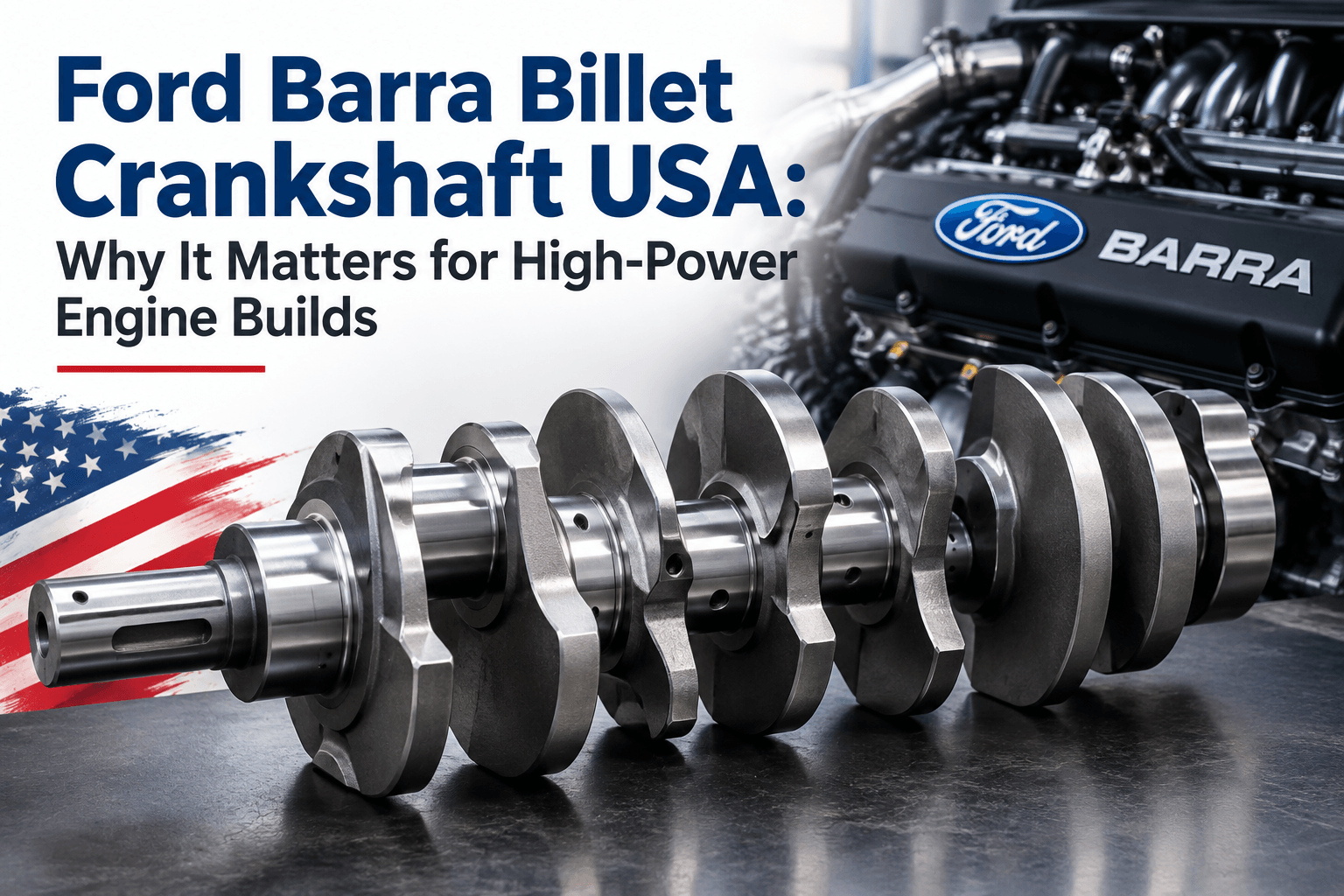
Billet crankshafts sit at the top of the hierarchy. They’re machined from a single solid block of high-grade steel, typically 4340 or similar aerospace-grade material. This process eliminates the internal stresses and inconsistencies found in cast and forged cranks, resulting in the strongest possible component.
How Is a Billet Crankshaft Made?
The billet manufacturing process starts with a solid steel bar, often weighing considerably more than the finished product. CNC machines precisely cut away material to create the final shape, with tolerances measured in thousandths of a millimetre.
This subtractive manufacturing approach means every crankshaft can be customised. Want a different stroke length? Need specific journal sizes? With billet, these modifications are straightforward. The finished product undergoes heat treatment, grinding, and polishing to achieve optimal surface finish and durability.
Why Does a Billet Crankshaft Matter for High-Power Engine Builds?
Strength and Durability Under Extreme Stress
When you’re pushing serious power, the crankshaft experiences enormous forces. Each combustion event creates massive pressure on the connecting rod journals, while the rotating assembly generates significant centrifugal loads. A billet crankshaft’s uniform grain structure handles these stresses far better than alternatives.
At power levels exceeding 800-1,000 horsepower, stock crankshafts become a genuine liability. The risk isn’t just reduced performance – it’s catastrophic failure. A crankshaft letting go at high RPM can destroy your entire engine and potentially damage the transmission too.
Precision Engineering for Maximum Performance
Beyond strength, billet crankshafts offer superior dimensional accuracy. This precision translates to better oil clearances, reduced vibration, and smoother operation throughout the rev range. For high-RPM applications, this consistency is non-negotiable.
The ability to customise stroke length opens up interesting possibilities. A stroker crankshaft increases displacement without boring the cylinders, giving you more torque and often better efficiency for your chosen application.
What Horsepower Can a Stock Barra Crankshaft Handle?
The factory Barra crankshaft is surprisingly robust. Most tuners agree it’ll handle around 600-700 horsepower with proper supporting modifications. Some have pushed stock cranks beyond this, but you’re essentially gambling at that point.
The turbo Barra’s forged factory crankshaft is stronger than the naturally aspirated cast version. However, once you’re targeting four-digit power figures, upgrading becomes essential rather than optional.
When Should You Upgrade to a Billet Crankshaft?
Signs Your Stock Crankshaft Is Reaching Its Limits
Several warning signs indicate your crankshaft is struggling. Unusual vibrations, particularly at certain RPM points, suggest the crank may be flexing or developing issues. Bearing wear patterns can also reveal problems – if you’re seeing uneven wear during rebuilds, the crankshaft might be the culprit.
Oil pressure fluctuations and knocking sounds are more serious symptoms requiring immediate attention. If you’re experiencing any of these issues on a high-powered build, don’t ignore them.
Is a Billet Crankshaft Worth the Investment?
For street cars making moderate power, a billet crankshaft might be overkill. The factory component handles daily driving duties perfectly well. However, if you’re building a dedicated drag car, competing in time attack, or simply want absolute peace of mind with a high-powered street machine, the investment makes sense.
Consider the cost of engine failure versus the price of prevention. A quality billet crankshaft might seem expensive upfront, but it’s far cheaper than rebuilding a scattered engine.
Key Features to Look for in a Quality Billet Crankshaft
Material Grade and Composition
Look for crankshafts made from 4340 steel or equivalent. This chromoly alloy offers excellent strength-to-weight ratio and fatigue resistance. Some manufacturers use even higher-grade materials for extreme applications.
Stroke Options and Customisation
Standard stroke crankshafts maintain factory displacement, while stroker options increase capacity. Common stroker configurations add anywhere from 3mm to 10mm of stroke. Consider your intended use – more stroke typically means more low-end torque but potentially reduced high-RPM capability.
Balancing and Finishing Quality
A properly balanced crankshaft is vital for smooth operation and longevity. Quality manufacturers balance their crankshafts to extremely tight tolerances. The surface finish on journals should be mirror-smooth to minimise bearing wear
How Much Does a Barra Billet Crankshaft Cost?
Don’t forget associated costs – you’ll likely need new bearings, potentially new connecting rods, and professional balancing of the complete rotating assembly.
Common Mistakes to Avoid When Choosing a Billet Crankshaft
Buying on price alone is the biggest mistake enthusiasts make. Cheap crankshafts often use inferior materials or lack proper heat treatment. Verify the manufacturer’s reputation and ask for material certifications.
Another common error is mismatching components. Your crankshaft, rods, and pistons need to work together as a balanced system. Consulting with experienced engine builders before purchasing prevents expensive compatibility issues.
Installation Considerations and Professional Support
Installing a billet crankshaft isn’t a backyard job. You’ll need proper measuring equipment, torque wrenches, and ideally a machine shop’s support. Bearing clearances must be checked meticulously, and the entire rotating assembly should be balanced together.
Finding a ford barra billet crankshaft USA experienced with Barra performance builds is invaluable. They’ll spot potential issues before they become problems and ensure your investment performs as intended.
Conclusion: Building a Bulletproof Barra for Serious Power
A billet crankshaft represents the ultimate foundation for any high-powered Barra build. While the stock crankshaft handles impressive power levels, serious builds demand serious components. The strength, precision, and customisation options available with billet simply can’t be matched by factory parts.
When planning your build, consider your power goals realistically. If you’re targeting 600 horsepower or less for street use, the factory crankshaft might serve you well. But for anyone chasing bigger numbers – whether for competition or bragging rights – a quality billet crankshaft is money well spent.
Take your time researching manufacturers, consult with experienced builders, and don’t cut corners on supporting components. Your Barra has the potential to make incredible power, but only if every component in the chain can handle the stress. Build it right the first time, and you’ll have an engine that delivers reliable performance for years to come. Good luck with your build!