

If you’ve opened an app store lately, you’ve probably noticed something: apps don’t feel like static tools anymore. They feel like they’re paying attention to you. That shift is basically the story of 2026, and it’s worth unpacking if you’re building, marketing, or just trying to keep up with where things are headed.
I spend a lot of my time thinking about how people actually find and use apps, not just how they’re built. So here’s the trend list, but filtered through that lens — what’s real, what’s noise, and what actually moves the needle this year.
AI Isn’t a Feature Anymore — It’s the Foundation
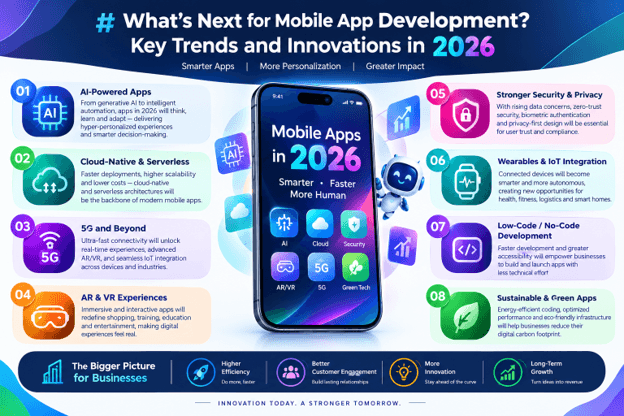
For a while, “AI-powered” was a marketing checkbox. Not anymore. In 2026, AI has moved from being bolted onto apps to being baked into how they’re built and how they behave. Agentic AI tools now sit inside the development pipeline itself, helping teams code, test, and ship faster, while inside the app, machine learning quietly personalizes everything from home screens to push notifications based on real user behavior. Generic, one-size-fits-all experiences are increasingly seen as a liability rather than a safe default.
For anyone thinking about discoverability, this matters more than it sounds. Apps that adapt to users tend to keep them longer, and retention is one of the strongest signals that both app stores and search engines reward.
Cross-Platform Is No Longer the Compromise
There was a time when “cross-platform” meant “good enough, but not quite native.” That reputation is fading fast. Frameworks like Flutter, React Native, and Kotlin Multiplatform have matured to the point where teams are choosing them not as a shortcut, but as the smarter long-term investment — one codebase, shared business logic, faster iteration across iOS and Android.
This is where Mobile App Development teams are quietly saving months of work. Instead of maintaining two separate builds, you maintain one shared core and ship updates to both platforms almost simultaneously. That speed matters when user expectations shift as quickly as they do now.
Low-Code and No-Code Are Changing Who Gets to Build
This one caught a lot of people off guard. Analysts have projected that low-code platforms will account for the majority of new application development by 2026, and enterprise teams have already leaned into it heavily. What used to require a technical co-founder now sometimes just requires a clear idea and the willingness to iterate.
I’ve seen this play out with agencies and consultancies too — teams like Kreo, who work at the intersection of design, strategy, and digital growth, are increasingly folding rapid prototyping into their process because clients want to see and test ideas before committing serious engineering budget. It’s less about replacing developers and more about compressing the distance between “idea” and “working product.”
Super Apps and Mini-App Ecosystems
Instead of ten separate apps for ten separate tasks, users are gravitating toward ecosystems — one app that hosts payments, messaging, bookings, and shopping through smaller mini-apps inside it. This shift is also influencing Ride-Hailing Clone App Development, where businesses are increasingly building scalable platforms that can support multiple services within a single app. It’s efficient for users and sticky for businesses, since every mini-app interaction keeps people inside one branded environment instead of bouncing to competitors.
Edge Computing, 5G, and Faster Everything
Nobody waits for a slow app anymore. Edge computing is pushing processing closer to the device instead of routing everything through distant servers, and wider 5G adoption is making richer, real-time experiences — think AR try-ons or live collaboration — actually practical at scale. Speed isn’t just a UX nicety here; it directly affects bounce rates, session length, and how favorably an app gets treated in store rankings.
Privacy-First Engineering Is No Longer Optional
Between tightening regulations and users who are simply more aware of how their data gets used, privacy has shifted from a legal checkbox to a design principle. Apps that are transparent about data use, minimize what they collect, and build security in from day one aren’t just avoiding fines — they’re building the kind of trust that keeps users from uninstalling.
Immersive Experiences Are Getting Practical, Not Just Flashy
AR and spatial computing are moving out of the “cool demo” phase and into real business use — remote training, virtual product try-ons, enterprise workflows. Cloud-based XR is also lowering the hardware barrier, so users don’t need expensive headsets to get a taste of immersive features anymore.
Why This All Matters Beyond the Code
Here’s the honest take: most of these trends aren’t really about technology for technology’s sake. They’re about attention. Every one of these shifts — faster load times, smarter personalization, tighter privacy, richer experiences — affects how long someone stays engaged, how likely they are to return, and how visible an app becomes organically. Good Mobile App Development in 2026 and strong discoverability aren’t separate conversations anymore; they’re the same conversation.
Final Thoughts
2026 isn’t asking teams to chase every trend on this list. It’s asking for judgment — knowing which shifts genuinely change how users experience an app, and which are just noise dressed up as innovation. AI in the pipeline, cross-platform as the default, faster low-code iteration, and privacy built in from the start: those are the ones worth funding now. The rest can wait until there’s a real business case behind them.